Introduction
On October 15, 1997, the Cassini Spacecraft was launched by NASA to be put into orbit around Saturn. The Cassini contained two elements: the actual spacecraft and the Huygens probe. The spacecraft was built and is managed by NASA's Jet Propulsion Laboratory while the Huygens probe was constructed by the European Space Agency. After a 7-year journey and four gravity-assists from other planets, the spacecraft reached Saturn and began orbiting in July of 2004. The spacecraft is equipped to (in effect) “see” certain wavelengths of light as well as “feel” different magnetic fields and dust particles. The spacecraft is 5,712 kilograms including fuel, the probe, etc. powered by 885 watts from radioisotope thermoelectric generators. In addition, more than 250 scientists across the world are studying the data that Cassini sends back to Earth.
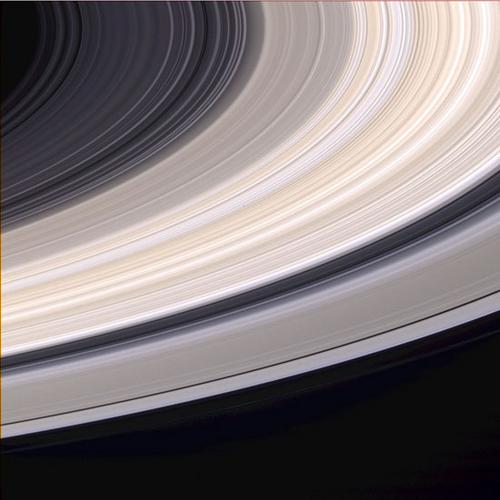 | A few days before entering Saturn's orbit, Cassini captured this natural color image of the rings. details.cfm?imageID=849 |
What has the Cassini Spacecraft revealed about Saturn's rings?
Saturn
is one of the most interesting planets of the solar system because of
its complex ring system. It is more intricate than any others of the
planets with rings. Some even call it the "Jewel of the Solar
System." Saturn's ring system is composed of hundreds of individual
rings, and it is believed that these particles are shattered pieces
from colliding moons, comets, and asteroids, ranging in size from
micrometer-sized grains to several meter diameter objects. The actual
age of the ring system is unknown, however the first confirmed
observation of them was by Galileo in the early 1600s. The Cassini
Spacecraft is a mission to explore this intricate ring system and
uncover many of the mysteries that these rings (and the rest of Saturn)
hold. One way it did this was by examining the physical
characteristics of some of the ring regions, listed below.
1.
There are seven major rings: A Ring-G Ring, but ordered E, G, F, A, B,
C, D, from the outside to the inside with the Cassini Division between
A and B
ii. Width: 300,000 km
iii. Thickness: 1,000-30,000 km
iv. Characteristics: “A broad and diffuse ring that is fed water ice from the moon Enceladus eruptions”
ii. Width: 8,000 km
iii. Thickness: 100-1,000 km
iv. Characteristics: “Possibly a disrupted moonlet and has a new arc since voyager mission”
ii. Width: 30-500 km
iii. Characteristics: “Contains kinky ringlets with wandering moons and transient clumps”
ii. Width: 14,600 km
iii. Thickness: 0.01 km
iv. Characteristics: Has dozens of spiral waves caused by ring-moons
ii. Width: 4,700 km
iii. Characteristics: Actually a ring, not just empty space
iv. Most gaps are caused by the gravitational pull of Saturn's moons on the ring particles. The Cassini Division is mainly affected by
ii. Width: 25,500 km
iii. Thickness: 0.01 km
iv. Characteristics: “Bright particles and full of unexplained structure”
ii. Width: 17,500
iii. Characteristics: “Home of the Maxwell Gap and dark particles”
ii. Width: 8,500 km
iii. Characteristics: “Nearly transparent ring that changes position”
Saturn’s Rings:
Very thin
Made up of ice particles & rocks
Look like rings because particles are moving so quickly
2. Cassini’s discoveries: July 2004
ii. New moons near rings
iii. Small moon stealing particles from F ring
iv. Enceladus, a small moon, is a main supplier of material for the largest ring, the E ring.
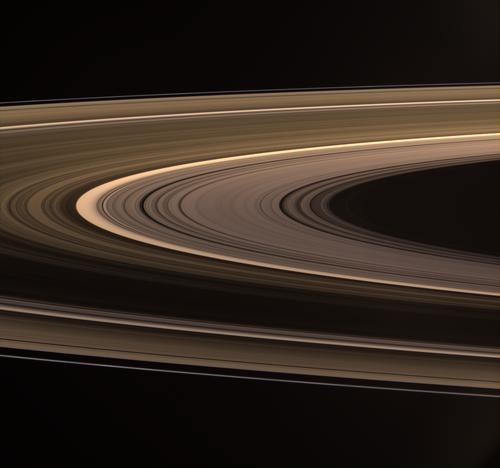
Saturn's rings in the naturally illuminated by the sun
March 18, 2008
Retrieved from: http://saturn.jpl.nasa.gov/multimedia/images/image-details.cfm?imageID=2998
More Facts about the Cassini Space Mission
The
Cassini Spacecraft used measurements called "occultations," through
which the light from stars or radio signals from the spacecraft are
monitored to reveal more about Saturn. These measurements have
uncovered new information that scientists were not able to detect
before the Cassini Space Mission. The occultations have shown how the
particle size varies across the rings of Saturn. The location of the
smaller and larger particles is able to show us more about the
collisions that occur between the particles. Also, while the exact
composition of the rings is unknown, the spacecraft has better
characterized the data that was known about the rings originally. The
Cassini Visible and Infrared Mapping Spectrometer (VIMS) uses what
scientists call spectral "fingerprinting." VIMS found evidence of iron
embedded in the ice particles and organic material in some regions.
Also, Cassini's color cameras show new and clearer images, which
further indicate how the composition of the rings varies with
location.
Cassini showed the importance of the interplay
of the moons with the rings. The spacecraft has also revealed that the
F ring, which is outside the main rings, has changed greatly since the
Voyager Mission. Cassini discovered a new moonlet within the A ring,
and the spacecraft's instruments have been able to detect objects about
the size of a football field by the way they have affected nearby ring
material. These objects are buried in the A ring but are too small to
clear a gap in the rings. A lot of the time, Cassini orbits Saturn in
the E ring. Also, Cassini detected that the atmosphere of at the edge
of the rings was mainly composed of oxygen, a surprise to all
scientists, though it is not breathable because it is so sparse.
Additionally, data from the Cassini Division shows that it is composed
more of dirt than of water ice or rock, which appears to be similar to
what was found on Saturn's moon Phoebe in earlier studies of the
planet, intriguing many scientists again about the origin of the rings.
Additionally, the Cassini spacecraft revealed two new partial rings (called "ring arcs") surrounding Saturn that each appear to be accompanying a moon. These partial rings are ahead of and trail behind Saturn's two moons, Anthe and Methone. Anthe and Methone both orbit in what is called a resonance in which the gravity of Saturn's larger moon, Mimas, is affecting their orbits. The ring particles associated with these moons is believed by scientists to be pieces of the moons shattered by impact with micrometeroids. They are only partial rings because Mimas' gravity interacts with the particles of the rings, affecting their span. The Cassini spacecraft was the first to reveal the arc accompanying Anthe and confirmed original detections of the Methone arc by Cassini's Magnetospheric Imaging Instrument. The images Cassini has returned to Earth also confirm earlier evidence of similar arcs around other smaller moons within the ring system of Saturn, such as Pan, Janus, Epimetheus and Pallene, and similarly, the arc in the G ring is affected by Saturn's larger moon, Mimas.
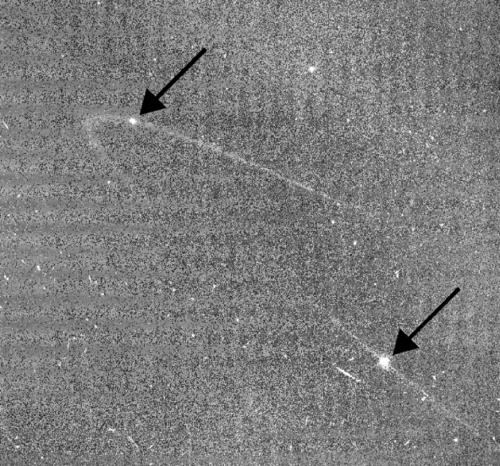 The ring arcs of Anthe and Methone. details.cfm?imageID=3217 | 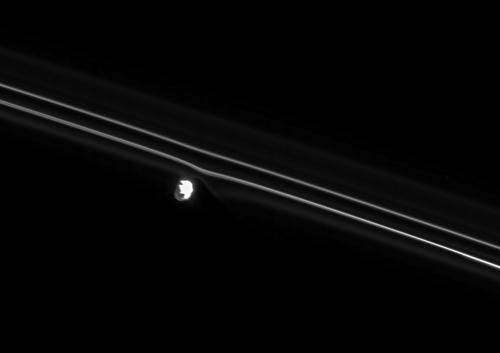 An image showing the effect of the gravity of the moon Prometheus. details.cfm?imageID=3205 |
Conclusion
The
Cassini Spacecraft was an important mission for astronomy because of
all it has revealed about Saturn. Not only did it reveal new
information about the rings, but also about Saturn's moons, their
composition, and the ways they interact with the planet's complex ring system. Cassini is still presently orbiting Saturn and
retrieving important data. The Cassini Prime Mission ended in June
2008, however it has been extended and is currently in its Cassini
Equinox Mission. Scientists hope to continue revealing new interesting data about this intricate planet, our "Jewel of the Solar System."
Sources
Munsell, Kirk, ed. "Cassini-Huygens: Mission to Saturn and Titan." Jet Propulsion Laboratory. 9 Dec. 2008. California Institute of Technology. 6 Dec. 2008
Thomson, Andrea. "New Partial Rings Discovered Around Saturn." Space.com. 6 Sep. 2008. Imaginova Corp. 8 Dec. 2008 <http://www.space.com
Site created by PHY 111 Group 4
Austin Halsey
Craig Haring
Adam Helsley
Greg Hoffman
Tasha Likins
Katie Strauss
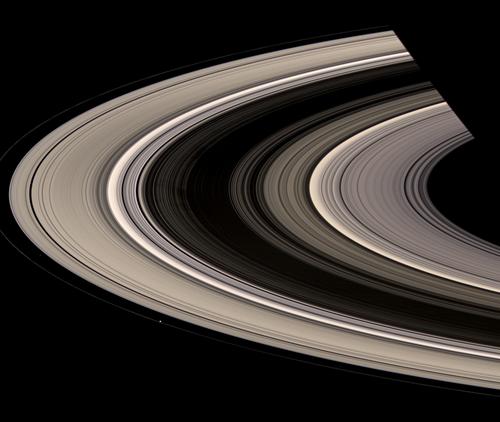
Cassini Image of the rings of Saturn
August 25, 2008
Retrieved from: http://saturn.jpl.nasa.gov/multimedia/images/image-details.cfm?imageID=3202
